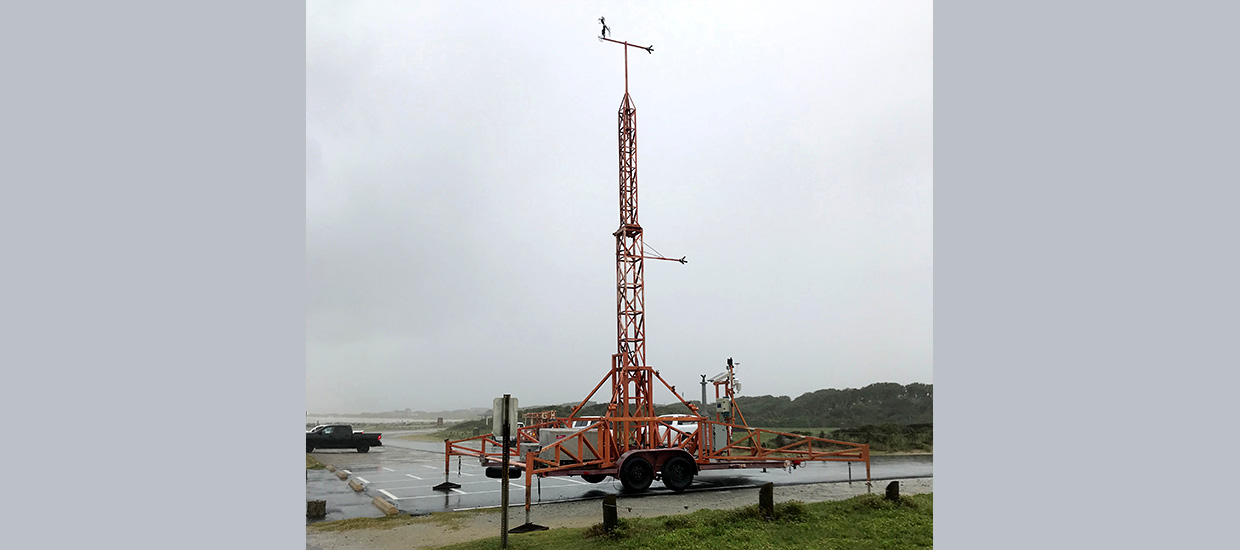
This photo shows one of the Florida Coastal Monitoring Program mobile towers deployed near Wilmington, NC, during the approach of Hurricane Dorian (2019).
Along with the overall behavior of hurricanes, we are also keenly interested in the evolution of the surface wind field under hurricanes, especially as they make landfall and travel inland. In collaboration with the University of Florida, our group made measurements of wind speed during the landfalls of Hurricanes Florence (2018), Michael (2018), Dorian (2019), Laura (2020), Delta (2020), Ida (2021), Ian (2022), and Milton (2024).
Some recent publications:
Takahashi, T., D. S. Nolan, and B. D. McNoldy, 2024: The vortex structure and near-surface winds of Typhoon Faxai (2019) during landfall. Part II: Evaluation of WRF simulations. Q. J. Roy. Meteorol. Soc.,150, 1643-1667. https://doi.org/10.1002/qj.4663.
Takahashi, T., and D. S. Nolan, 2024: The vortex structure and near-surface winds of Typhoon Faxai (2019) during landfall. Part I: Observational analysis. Q. J. Roy. Meteorol. Soc.,150, 1172-1193. https://doi.org/10.1002/qj.4641.
Rozoff, C. M., D. S. Nolan, G. H. Bryan, E. A. Hendricks, and J. C. Knievel, 2023: Large-eddy simulations of the tropical cyclone boundary layer at landfall in an idealized urban environment. Journal of Applied Meteorology and Climatology, 62, 1457-1458. https://doi.org/10.1175/JAMC-D-23-0024.1.
Hlywiak, J., and D. S. Nolan, 2022: Targeted artificial ocean cooling to weaken tropical cyclones would be futile. Communications Earth & Environment, 3, Art. 195., https://doi.org/10.1038/s43247-022-00519-1.
Hlywiak, J., and D. S. Nolan, 2022: The evolution of asymmetries in the tropical cyclone boundary layer wind field during landfall. Mon. Wea. Rev., 150, 529-549. https://doi.org/10.1175/MWR-D-21-0191.1.
Hendricks. E. A., J. C. Knievel, and D. S. Nolan, 2021: Evaluation of boundary layer and urban-canopy parameterizations for simulating wind in Miami during Hurricane Irma (2017). Mon. Wea. Rev., 149, 2321-2329.
Hlywiak, J., and D. S. Nolan, 2021: The response of the near-surface tropical cyclone wind field to inland surface roughness length and soil moisture content during and after landfall. J. Atmos. Sci., 78, 983-1000.
Nolan, D. S., B. D. McNoldy, and J. Yunge, F. J. Masters, and I. M. Giammanco, 2021: Evaluation of the surface wind field over land in WRF simulations of Hurricane Wilma (2005). Part II: Surface winds, inflow angles, and boundary layer profiles. Mon. Wea. Rev., 149, 697-713.
Nolan, D. S., B. D. McNoldy, and J. Yunge, 2021: Evaluation of the surface wind field over land in WRF simulations of Hurricane Wilma (2005). Part I: Model initialization and simulation validation. Mon. Wea. Rev., 149, 679-695.
Shi, L., M. Olabarrieta, D. S. Nolan, and J. C. Warner, 2020: Tropical cyclones rainbands can trigger meteotsunamis. Nature Comm., 11, 678.
Hlywiak, J., and D. S. Nolan, 2019: The influence of oceanic barrier layers on tropical cyclone intensity as determined through idealized, coupled numerical simulations. J. Phys. Ocean.,49, 1723-1745.
Klotz, B. W., and D. S. Nolan, 2019: SFMR surface wind undersampling over the tropical cyclone lifecycle. Mon. Wea. Rev., 147, 247-268.
Nolan, David S., Jun A. Zhang, and Eric. W. Uhlhorn, 2014: On the limits of estimating the maximum wind speeds in hurricanes. Mon. Wea. Rev., 142, 2814-2837.